
TACEO Addresses Voter Registration, List Maintenance Questions Ahead of October 5 Deadline
AUSTIN, TX – With one month until the October 5 deadline to register to vote in the November 3, 2026 General Election, the Texas Association of County Election Officials (TACEO), which represents county election officials across Texas’ 254 counties, is issuing a series of explainer materials addressing common questions and misconceptions about the voter registration and voter list maintenance process in Texas.
"As the local government entities responsible for both registering eligible Texas voters and conducting list maintenance to maintain the accuracy and integrity of Texas' voter rolls, Texas counties take our duty to educate voters on the facts of the voter registration process very seriously," said TACEO President Kristin Miles, Bastrop County Elections Administrator. "While each election cycle brings different challenges, the potential for misinformation and misconceptions to undermine confidence in our elections is always a top concern, requiring constant vigilance, clear communication, and consistent voter education to ensure Texans know their rights and responsibilities when registering to vote and casting a ballot.
"Texas elections are among the most secure and transparent in the nation because of the tireless, dedicated work that local election officials in all 254 counties undertake every single day to safeguard our sacred right as U.S. citizens. Eligible Texas voters should enter election season with confidence, and we look forward to continuing our efforts to provide Texans with the facts about voter registration in our state."
Voter Registration in Texas: The Basics
Texans register to vote with their county voter registrar, not the state.
To be eligible to register to vote in Texas, you must be:
A United States citizen;
A resident of the county where you submit your application;
18 years of age on Election Day
Not finally convicted of a felony and still serving a sentence; and
Not declared by a court to be totally or partially mentally incapacitated without the right to vote.
For new applicants, a valid voter registration application must be physically signed, submitted, and postmarked to their county voter registrar by October 5th to participate in the November 3, 2026 General Election.
Texas does not have online voter registration, but voter registration records can be updated online through Texas.govor through the Department of Public Safety's (DPS) online portal when Texans update their Driver License or State ID card.
Texas voter records do not include party affiliation, though public records disclose the party primary elections in which a voter has participated.
There is no such thing as a "registered Republican, Democrat, or Libertarian," in the Texas voter registration database.
Texas voters can check their registration status through the Texas Secretary of State's personal voter portal, or by contacting their county voter registrar directly to verify registration status, if needed.
“Suspense” Status is an Address Question, Not a Removal
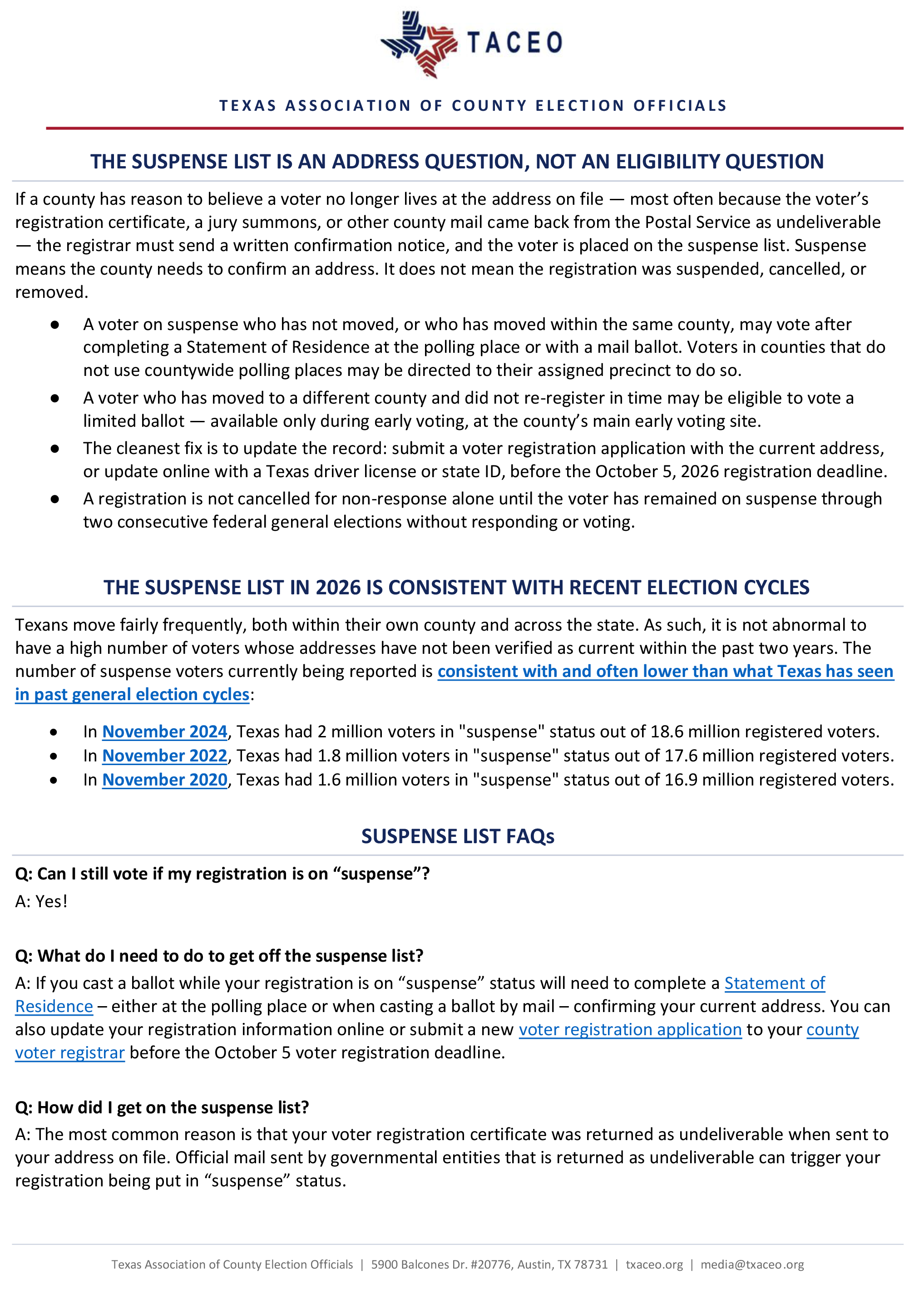
Recent headlines covering the roughly 1.2 million Texas voter records currently in "suspense" status has given the mistaken impression that these voters' registrations have been permanently suspended or cancelled. They have not.
Here's what Texas voters need to know about the "suspense" process:
A voter is placed on "suspense" when the county voter registrar has reason to believe the voter no longer lives at the address on file.
This usually happens because the voter's registration certificate that is automatically mailed out every two years is returned as undeliverable.
When this happens, Texas law requires the county voter registrar send a forwardable confirmation notice requesting the voter confirm a current resident address, and the voter is placed on the suspense list.
A voter who has not moved, or who has moved within the same county, may vote after completing a Statement of Residence – at the polling place or with a mail ballot.
In counties that do not use countywide polling places on Election Day, the voter may be directed to their assigned precinct to complete the form and cast a ballot.
A voter who has moved to a different county and does not re-register by October 5 may still be eligible to vote a limited ballot – but only during the Early Voting period at the county's main early voting location.
A voter's registration is not cancelled for non-response alone until a voter has remained on suspense through two consecutive federal general elections without responding or voting.
To make sure their voter registration address is updated, Texas voters should check their registration status through the Texas Secretary of State's personal voter portal or contact their county voter registrar directly to resolve any outstanding questions about their voter registration status.
Texans move fairly frequently, both within their own county and across the state. As such, it is not abnormal to have a high number of voters whose addresses have not been verified as current within the past two years. The number of suspense voters currently being reported is consistent with and often lower than what Texas has seen in recent election cycles:
In March 2026, Texas had 1.2 million voters in "suspense" status out of 18.6 million registered voters.
In November 2024, Texas had 2 million voters in "suspense" status out of 18.6 million registered voters.
In March 2024, Texas had 2.1 million registered voters in "suspense" status out of 17.9 million registered voters.
In November 2022, Texas had 1.8 million voters in "suspense" status out of 17.6 million registered voters.
In March 2022, Texas had 1.2 million voters in "suspense" status out of 17.1 million registered voters.
In November 2020, Texas had 1.6 million voters in "suspense" status out of 16.9 million registered voters.
In March 2020, Texas had 2 million voters in "suspense" status out of 16.2 million registered voters.
Click here or on the image below for a one-page breakdown of the "suspense" status in Texas voter registration records.
How Counties Perform Voter List Maintenance
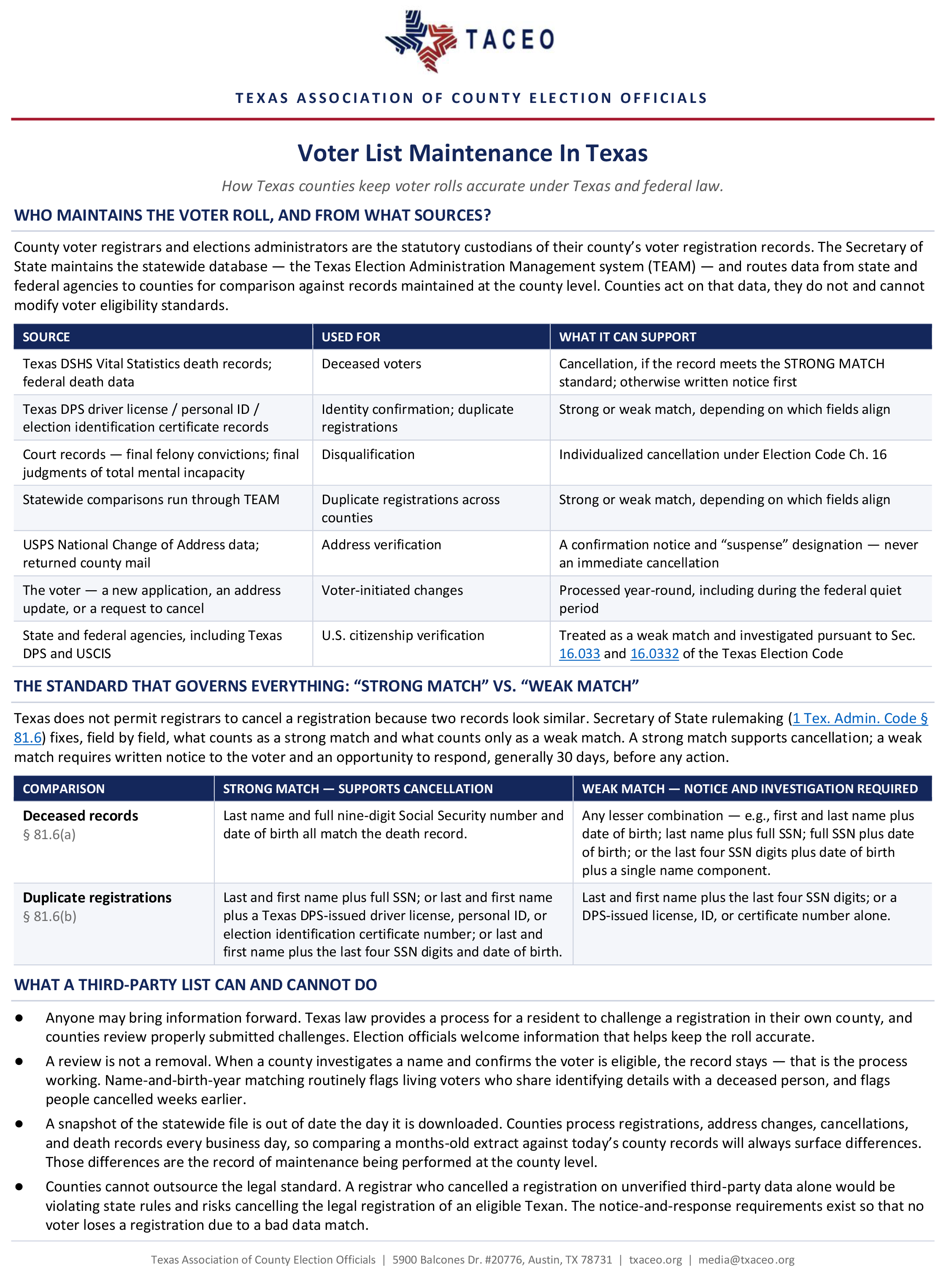
County voter registrars and election administrators are the statutory custodians of their county’s voter registration records, and list maintenance is year-round work that involves, among other activities, comparing the voter roll against death records from the Texas Department of State Health Services (DSHS) and federal death data such as the Social Security Administration's Death Master File, against Texas Department of Public Safety (DPS) records, against court records on final felony convictions and final judgments of total mental incapacity, and against statewide comparisons for duplicate registrations. County officials also process voter-initiated updates and cancellations continuously, and receive information through the Texas Secretary of State's office regarding comparisons to the U.S. Citizenship and Immigration Services' SAVE database.
Where are voter registrations kept?
Most Texas counties use the state's voter registration database – the Texas Election Administration Management (TEAM) system – to manage voter registration records.
These are referred to as 'online' counties.
However, several dozen of the largest Texas counties maintain their own databases that communicate and synchronize records with the state database to ensure voter records are updated when a voter moves, changes names, dies, or is declared ineligible.
These are referred to as 'offline' counties.
The majority of Texas voters have records that are maintained by a third-party database that must sync with the state's TEAM database on a regular basis to keep voter registrations in the statewide database current.
Though the Texas Secretary of State has acknowledged issues with TEAM's functionality, Texas county voter registrars have layers of safeguards meant to back up valid voter registration records and fulfill their duties to maintain a current, updated list of registered voters.
When can a county cancel a Texas voter's registration?
A county can cancel a voter's registration if they receive information that a voter does not meet eligibility criteria under Texas law.
Texas law does not allow a cancellation based on a mere resemblance between two records.
Secretary of State rulemaking sets out, field by field, which records qualify as a “strong match” and which qualify only as a “weak match.”
A strong deceased-record match requires the last name, the full nine-digit Social Security number, and the date of birth to align with the death record.
A weak match, which is any lesser combination of criteria, cannot support cancellation on its own, but triggers written notice to the voter and an opportunity to respond, generally 30 days, before a county may take action.
Data comparisons based on commercially-available and public data cannot substitute for the process that Texas statutes and agency rules require.
Every strong-match pathway in Texas rule depends on a Social Security number or a state-issued identification number, both of which are confidential, not part of the public voter file, and are not available in obituary databases, county appraisal records, commercial change-of-address products, or similar sources.
When a county investigates a name and confirms the voter is eligible, the registration stays. That is the process working.
Click here or on the image below for a one-page breakdown of how counties perform list maintenance on a regular basis.
What kind of list maintenance can counties perform between now and the November General Election?
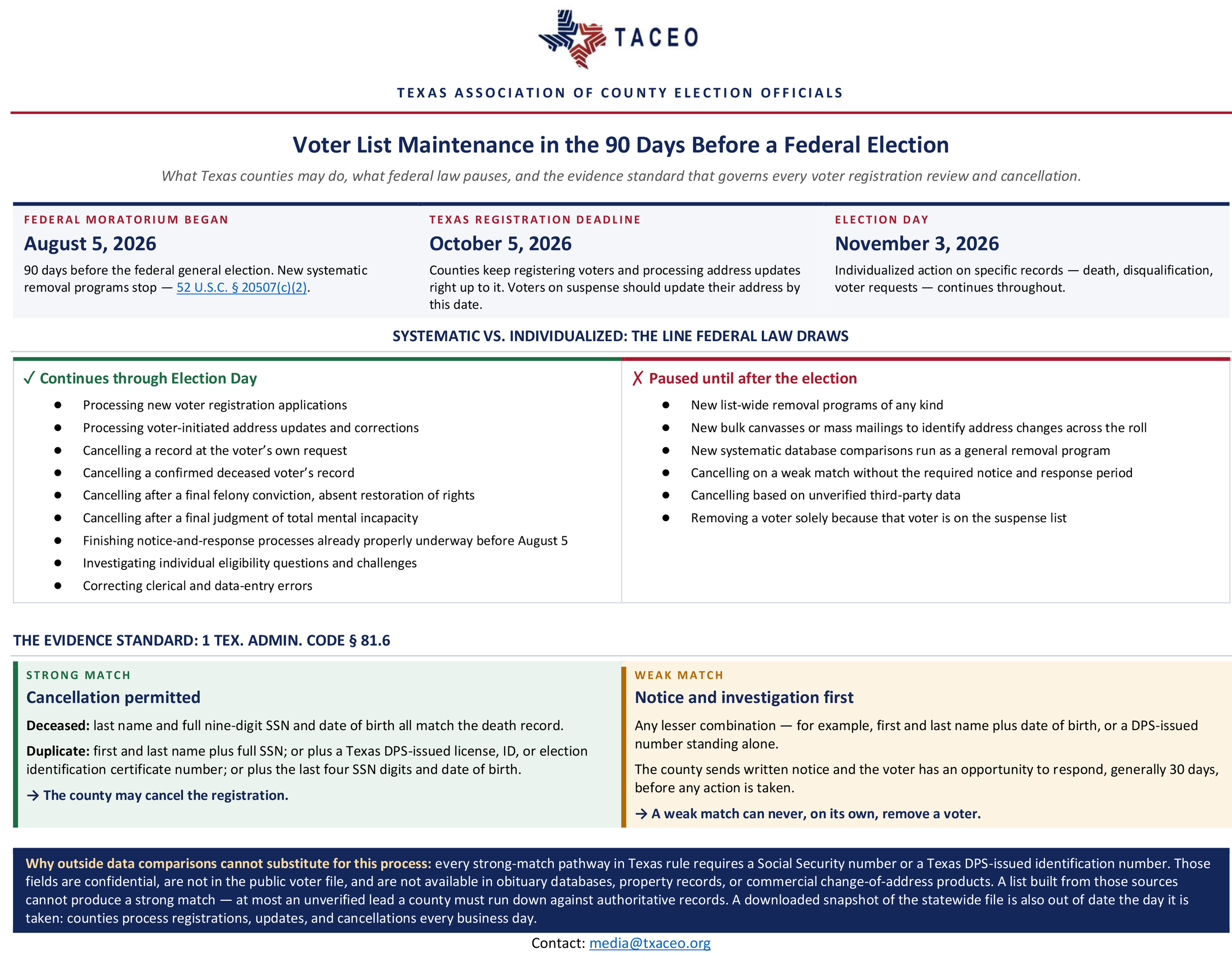
Section 8 of the 1993 National Voter Registration Act (NVRA)limits what any county voter registrar can do within 90 days of a federal election – August 5, 2026 for the current cycle.
Counties can continue to register voters who submit registrations or update their address before the October 5 deadline.
Counties can still cancel voter registrations during this period if:
The voter dies;
The voter is finally convicted of a felony;
The voter is finally judged for total mental incapacity; or
The voter requests his or her record be cancelled.
Counties may not launch any new list-wide removal program during the 90-day moratorium period before a federal election, nor can they cancel a registration based on a "weak" match or on unverified third-party data.
Any Texan who believes a specific registration in their county should be examined has a lawful process available, and county officials review properly submitted challenges.
If the challenge was initiated after August 5, the registration cannot be cancelled until after Election Day.
Click here for a one-page breakdown of how counties can perform voter list maintenance in the 90 days before a federal election.
What is happening when different sources show different voter registration data?
A downloaded snapshot of the statewide voter file is out of date the day it is taken.
Counties process registrations, address changes, and cancellations every business day, so comparing a months-old extract against current county records will always surface differences.
Election officials want an accurate voter roll, no one has a greater stake in it.
What Texas Voters Should Do Before October 5
Check your registration status and address at VoteTexas.gov, or with your county voter registrar.
If your record shows “suspense,” update your address – onlinewith a Texas driver license or state ID, or by submitting a new voter registration application to your county voter registrar.
If you have moved, update your registration by October 5 rather than waiting until Election Day, as the options available to voters who moved across county lines are narrower after the deadline.
If you see a claim about your county’s voter roll and want to know whether it is accurate, reach out to your county election office. They are the office that maintains the record.
About TACEO
TACEO is a nonpartisan association representing county election officials across Texas’ 254 counties, working to promote integrity, transparency and public trust in Texas elections. Through collaborative education, innovative resources, and unwavering support for all county election officials, TACEO works to build a community marked by integrity, excellence, and public trust in our electoral system. Learn more at https://www.txaceo.org/
###
