
What Texas Voters Need to Know Before Heading to the Polls: A Guide from Texas Election Officials
AUSTIN, TX – The Texas Association of County Election Officials (TACEO), which represents election officials across Texas’ 254 counties, today released a guide for Texas voters on what to expect at the polling place ahead of the Early Voting period that runs from Monday, October 19th through Friday, October 30th, and Election Day on Tuesday, November 3rd.
The guide covers ID requirements for voting, what happens at the check-in table, the provisional ballot process, activities allowed in or near polling places, how Texas voting equipment works, and the roles of state inspectors, poll watchers, and congressional observers at polling places.
"County election officials across Texas always want to ensure that voting is as straightforward and seamless as possible, and the best thing voters can do is know what to expect before they arrive at a polling place," said TACEO President Kristin Miles, Bastrop County Elections Administrator. "Make sure to bring an approved photo ID, leave your cell phone in your pocket when entering the voting room, avoid wearing political apparel, and know that if there is a question about your registration, poll workers and county election officials will take every step necessary to resolve it so that you can vote with confidence. Texas law gives every eligible voter a way to cast a ballot, and county election officials and our poll workers are there to help you do it. If you have questions, we encourage you to contact your county election office before heading to the polls."
Where to Vote
During the Early Voting period, voters can cast a ballot at any polling location in the county where they are registered.
On Election Day, voters who are registered in a county that participates in the Countywide Polling Place Program can cast a ballot at any polling location in the county – commonly known as 'vote centers.'
In counties that do not participate in this program, voters must cast a ballot at a polling location associated with the specific precinct where they are registered.
To view Early Voting and Election Day polling locations and hours, please visit the Texas Secretary of State's voter portal or contact your county election office.
What to Bring: ID Requirements for Voting
Voters must bring one of the seven approved forms of government-issued photo ID to cast a ballot in person, which include:
Texas Driver License
Texas Personal ID Card
Texas Handgun License
Texas Election Identification Certificate (EIC)
U.S. Military ID Card
U.S. Citizenship Certificate (with photo)
U.S. Passport (book or card)
For voters aged 18-69, IDs can be expired for up to four years. For voters 70 and older, an ID can be expired for any length of time, as long as it is otherwise valid.
If you don't possess and can't reasonably obtain one of the seven approved forms of government-issued photo ID, Texas law allows voters to cast a regular ballot by presenting a supporting form of identification – such as your voter registration certificate, a current utility bill, a bank statement, a government check, paycheck, or certified birth certificate – and signing a Reasonable Impediment Declaration (RID), which is available at each polling location.
For more information on this process, click here.
Checking In and Confirming Your Address
When you arrive at the check-in table, an election worker will ask for your ID, look up your record on the list of registered voters – usually with an electronic pollbook system – and confirm you are the same person listed on the county's official list of registered voters.
If the name on your ID does not exactly match what is on the official list of registered voters, you can still vote so long as it is "substantially similar" – such as 'Bill' instead of 'William,' a missing middle name, or a maiden name. You will be asked to sign a short statement affirming you are the same person.
If your county needs to confirm your address, including for those whose voter registration status is in "suspense," you will be asked to complete a short Statement of Residence form confirming where you live, and in most cases you will be able to vote a regular ballot. For more information on the "suspense" list process, click here.
If your name is not on the official list of registered voters, the poll worker will first try to locate your registration, including by checking with the county voter registrar. If your registration still cannot be confirmed, you can cast a provisional ballot.
How Provisional Ballots Work
A provisional ballot is a real ballot that is kept separate from regular ballots until a voter's eligibility is reviewed and confirmed by the county's Early Voting Ballot Board (EVBB).
The process works in five steps:
Name not on the list: a poll worker is unable to confirm your registration at check-in;
Sign an affidavit: you will be asked to sign a sworn statement that you are registered and eligible to vote in the jurisdiction where you are registered;
Cast a provisional ballot: follow instructions from the poll worker in casting your ballot, which is then sealed and kept separately from regular ballots;
Registration review: After you vote, the county voter registrar will research your registration record; and
Decision by EVBB: In the days after Election Day, the county's Early Voting Ballot Board – which meets before the canvass of votes and includes appointees of both political parties – will make a determination as to whether your ballot will be counted, based on the findings of the county voter registrar.
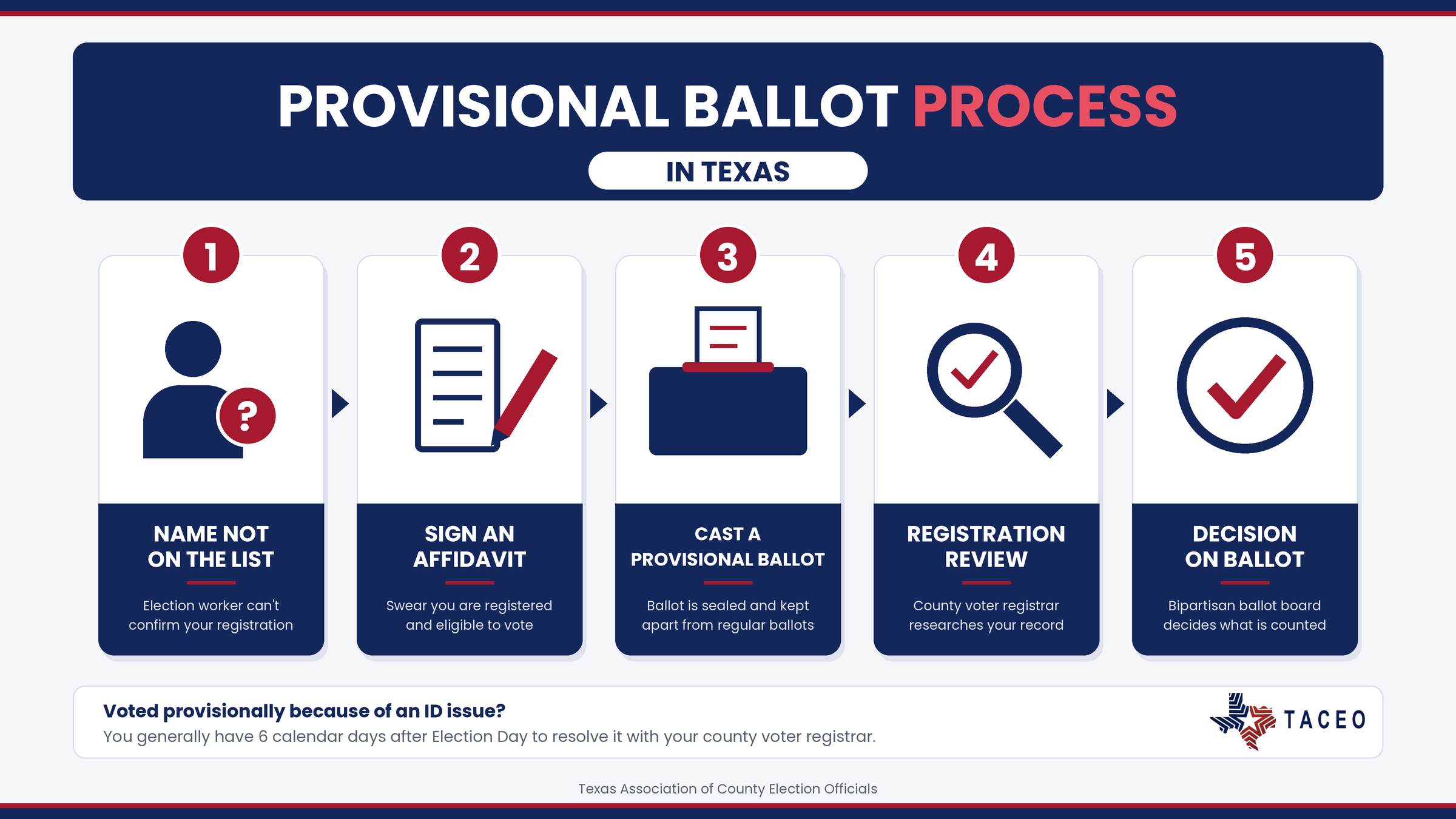
If you voted provisionally due to an issue with your ID, you have six calendar days after Election Day to visit the county voter registrar and resolve it. You will receive a written notice with instructions on this process.
Limited Ballots
Limited ballots are used when a voter is registered in a Texas county other than their current county of residence. They include only the races on the ballot that are in common between the two counties.
For example, someone who recently moved from El Paso County to Jefferson County would be able to vote a limited ballot that includes statewide races like U.S. Senate and Governor, but not in state Senate, House, or congressional contests.
Limited ballots are only an option during the Early Voting period, and cannot be cast on Election Day.
Limited ballots can only be cast at the county's main early voting polling place.
If you need more information about casting a limited ballot, please contact your county election office first before going to the polls.
What Is – and Isn't – Allowed at a Polling Location
Cell Phones: Voters may not use a cell phone, tablet, laptop, or similar device inside the room where voting is taking place. Outside that room – in a hallway or in line – you may use your phone to check e-mail, text, or look over a sample ballot, but you may not make a phone or video call. Recording sound or images within 100 feet of the voting stations is prohibited.
Written Notes: Voters may bring their own written materials, including a marked-up sample ballot or voter guide, into the voting booth to help them vote. Those materials cannot be displayed or handed out as campaign material.
Political Apparel: Within 100 feet of the polling place entrance, no one can wear or display any clothing, buttons, signs, or apparel relating to a candidate, measure, or political party, regardless of whether that candidate or issue is on the ballot. You may be asked by a poll worker to cover or remove any prohibited apparel before entering the polling place.
Electioneering: Displaying campaign signs, passing out campaign literature, circulating a petition for signatures, or telling voters to cast a ballot for or against a particular candidate or measure is prohibited within 100 feet of an entrance to a polling location or within 20 feet of a designated curbside voting parking space reserved for voters who are physically unable to enter the polling place. Amplified electioneering – such as using a megaphone or loudspeaker – is prohibited within 1,000 feet of the polling place entrance.
Firearms: The Texas Penal Code generally prohibits bringing a firearm onto the premises of a polling place while voting is underway. Peace officers are the exception, whether they are on or off duty.
For additional guidance on activities prohibited at Texas polling locations, click here.
Voting Systems
Texas currently has two types of certified voting systems: those manufactured by Hart InterCivic (based in Austin, TX) and Election Systems & Software (or ES&S, based in Omaha, NE). All Texas counties use one of these two systems for conducting elections in Texas.
As of September 1, 2026, all voting systems used in Texas are required to produce a physical, auditable paper ballot. Depending on the equipment a county uses for conducting elections, voters will cast ballots using one of these methods:
Hand-marked paper ballots: You mark your choices with a pen or marker and place the ballot in a ballot box or scanner.
Ballot marking devices: You make your selections on a touchscreen, and the device prints a paper ballot showing your choices. You review it and then place it in a scanner or ballot box.
Optical scanners: These count paper ballots, whether marked by hand or printed by a ballot marking device.
Electronic voting machines with a paper record:You vote on screen and review a summary of your choices. The machine produces a paper record of your vote that is kept by election officials.
Voting machines in Texas are never connected to the internet, nor do they even have the capability of being connected to the internet or any other wireless network. County election officials conduct public Logic & Accuracy testing before and after each election to confirm the equipment accurately records and counts the choices voters make. Counties also conduct a hash validation test of the voting equipment to ensure the underlying software installed in the voting systems has not been altered.
County election officials conduct a Post-Election Hand Count Audit, which involves a manual review of paper ballots in a random selection of precincts to verify the accuracy of electronic voting systems.
After the election, county election officials also conduct a Risk-Limiting Audit (RLA), using a random sample of paper ballots to confirm that reported results are accurate.
Electronic pollbooks used to check voters in are typically connected through a secure network so a voter cannot check in at more than one location, but these systems are completely separate from the voting equipment.
Every polling place must offer at least one accessible voting device to accommodate Texas voters with disabilities, allowing them to vote independently and privately. Voters who are physically unable to enter the polling place may also use curbside voting by requesting an election officer bring a ballot to the entrance of the polling place or to a car parked at the curbside.
Reminder: Please take the time to double-check your ballot before it is cast. If your voting equipment prints a paper ballot or paper record, make sure all of your choices are reflected accurately before printing, and check again before depositing your ballot into a scanner or ballot box. Remember: the paper stays with election officials and is the record that can be used in the event of a manual audit or recount.
Who's Allowed in a Polling Place
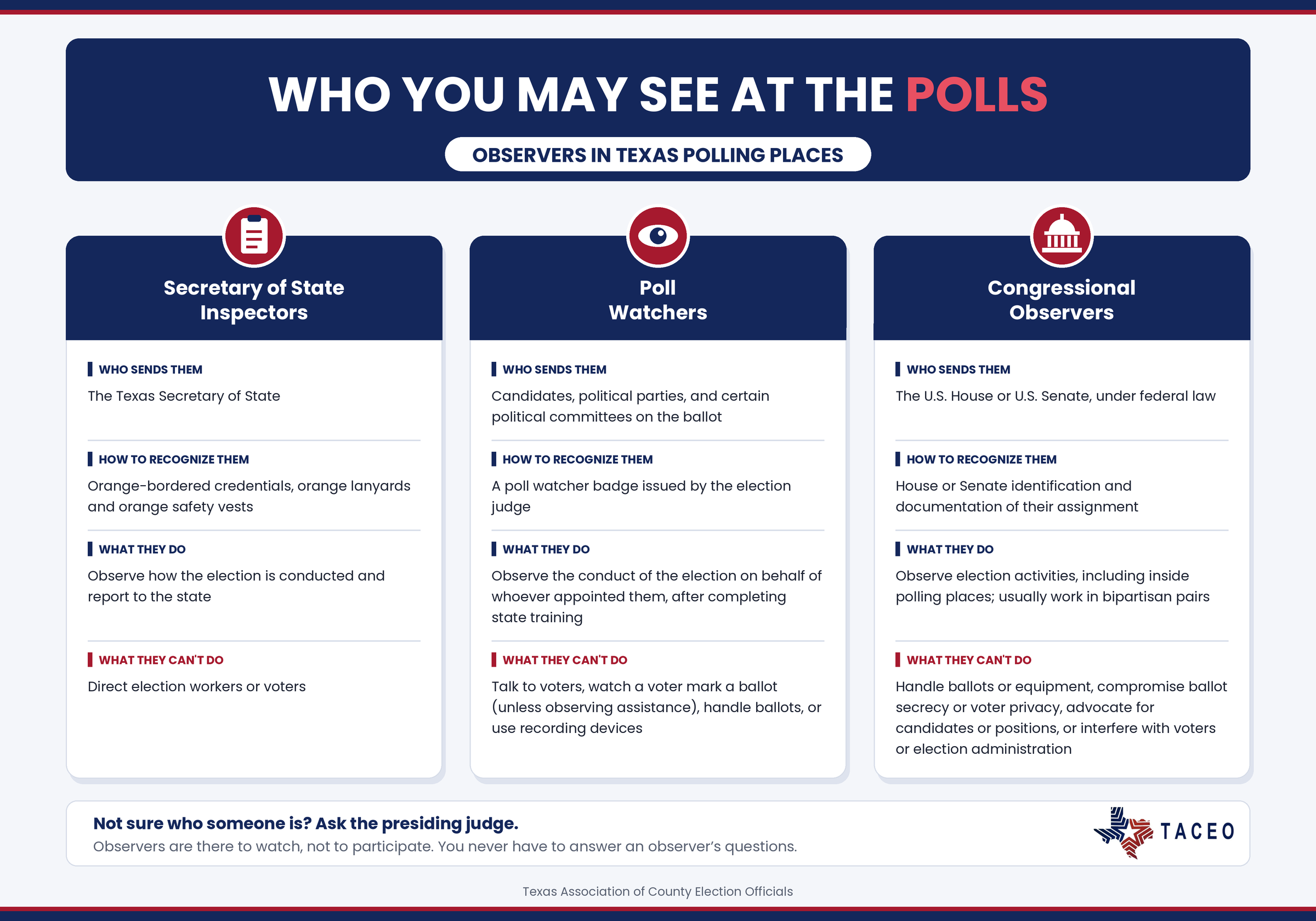
Texas law strictly limits who may be inside a polling location. Besides voters and the election judges and clerks who administer the election, the only individuals allowed inside a polling place are:
People authorized to assist voters;
Children accompanying a parent who is voting;
Peace officers;
Election inspectors appointed by the Texas Secretary of State;
Election observers appointed by Congress; and
Poll watchers appointed by a candidate, political party, or specific-purpose political action committee.
Election inspectors are appointed by the Texas Secretary of State, and consist of trained state agency employees who volunteer to observe the voting process and take notes at a polling location or at the county's central count station. Election inspectors do not interact with voters or direct election workers, and are clearly identified with orange-bordered credentials, orange lanyards, and orange safety vests.
Congressional observers are appointed by the U.S. House or Senate under federal law, and are authorized to observe election activities, usually working in bipartisan pairs. Congressional observers do not handle ballots or equipment or interfere with the election administration process, and wear House or Senate identification and carry documentation of their assignments.
Poll watchers are appointed by candidates, political parties, and specific-purpose political action committees supporting or opposing measures on the ballot, authorized to observe the conduct of the election after completing a training course administered by the Texas Secretary of State. Poll watchers are not allowed to talk to voters, handle ballots, or use recording devices, and must wear a poll watcher badge issued by the election judge.
Every election judge, clerk, state inspector, and peace officer on duty at a polling place must wear a tag or badge identifying themselves, and congressional observers carry House or Senate credentials. The presiding judge at each polling place verifies credentials and has the authority to keep order in a polling place.
If you have a question about who someone is, ask the presiding judge. As a voter, you do not have to answer questions from an observer, and no observer may interfere with your vote or the voting process. Concerns about anyone's conduct should be directed to the presiding judge or to your county election office.
Voters with additional and specific questions about the election process in Texas are encouraged to contact their county election office before the polls open for Early Voting on Monday, October 19th.
About TACEO
TACEO is a nonpartisan association representing county election officials across Texas’ 254 counties, working to promote integrity, transparency and public trust in Texas elections. Through collaborative education, innovative resources, and unwavering support for all county election officials, TACEO works to build a community marked by integrity, excellence, and public trust in our electoral system. Learn more at https://www.txaceo.org/
###
